
Chapter 2: Convenience Stores 4
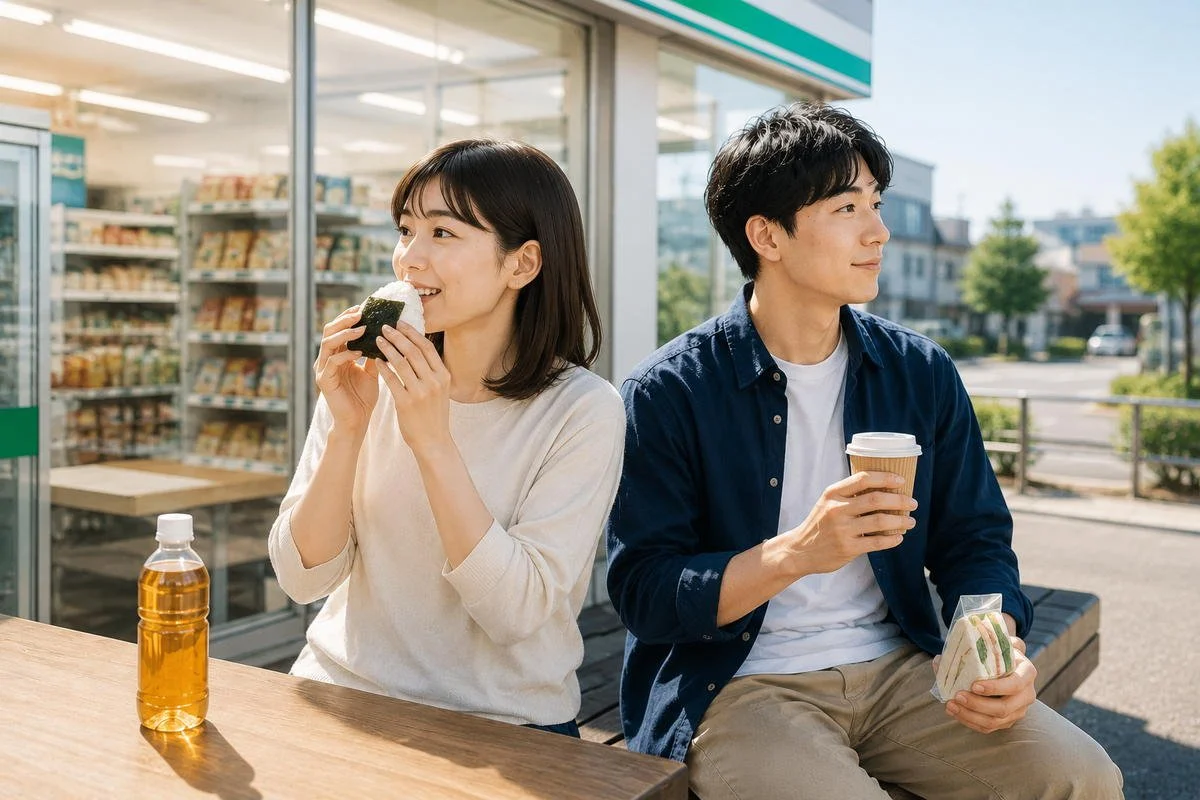
Eating Inside or Outside the Store
Whether you can eat inside a convenience store depends on the location.
Some stores have clearly marked seating areas where customers are welcome to enjoy food purchased on-site. Others are designed only for quick shopping and provide no dining space at all.
If there is no seating area, avoid eating near the register, blocking the entrance, or sitting on the ground outside the store. Instead, take your food to your hotel, a designated rest area, a park where eating is permitted, or another appropriate location.
This is especially important near temples, shrines, residential neighborhoods, and private property.
Remember, just because a convenience store sells food does not necessarily mean it is an appropriate place to eat it.
Is It Acceptable to Eat While Walking?
Eating while walking is less common in Japan than it is in many other countries.
Although it is not always prohibited, it may be considered inconsiderate in crowded areas such as shopping streets, train stations, or busy sidewalks, where food or drinks could spill onto other people.
In popular tourist districts that specialize in street food, designated eating areas are often provided.
When possible, it's better to stop, enjoy your food in one place, dispose of your trash properly, and then continue your walk.
This is particularly important when eating foods with sauces, ice cream, or hot drinks that are easy to spill.
Trash and Recycling at Convenience Stores
One surprise for many visitors is that Japan has relatively few public trash cans.
Some convenience stores provide waste bins, but they are primarily intended for items purchased at that store. Depending on the location, the bins may be inside the store, near the entrance, or beside a seating area.
Trash is usually separated into categories such as burnable waste, plastic bottles, cans, and glass.
Avoid bringing unrelated trash from your hotel, rental car, or sightseeing activities into a convenience store simply because you happen to find a bin.
If no trash can is available, keep your waste with you until you find an appropriate place to dispose of it.
Carrying a small plastic or reusable bag for wrappers, tissues, and other small items can make this much easier.
Local Tip
Don't assume every convenience store has public trash cans.
Many locations have removed them because they were frequently misused.
Keeping a small sealable bag in your backpack or daypack is one of the simplest ways to make traveling around Japan more comfortable.
Restrooms at Convenience Stores
Some Japanese convenience stores allow customers to use their restrooms, but availability varies from one location to another.
In suburban and rural areas, restrooms are often available and clearly marked. In busy city centers, entertainment districts, and around major train stations, they may be locked, reserved for customers, or unavailable altogether.
If you're unsure, it's perfectly polite to ask.
You can say:
Toire o tsukatte mo ii desu ka?
"May I use the restroom?"
If you're using the restroom at a small independently operated store or in a rural area, buying a drink or another inexpensive item is a thoughtful gesture.
As always, leave the restroom clean and avoid staying longer than necessary.
Using Convenience Store ATMs
Convenience-store ATMs are among the most useful services for international travelers.
While some foreign bank cards may not work at every bank ATM in Japan, ATMs inside major convenience-store chains often accept a wide range of international cards.
Most also provide English-language menus.
Before your trip, it's worth checking whether your bank charges international withdrawal fees or requires advance travel notification.
Keep in mind that withdrawal limits, supported cards, and operating hours may vary.
Even in a 24-hour convenience store, ATM services can occasionally be unavailable during late-night maintenance.
When using an ATM, stand close to the machine, shield your PIN from view, and make sure you collect your card, cash, and receipt before leaving.
Printing, Copying, and Scanning
The multifunction copiers found in many Japanese convenience stores do far more than make copies.
Depending on the store and the machine, you may be able to print documents and photos, scan files, send faxes, purchase tickets, or print directly from a USB drive or smartphone.
These services are especially useful if you need boarding passes, reservation confirmations, visa documents, maps, or emergency copies while traveling.
Although English menus are often available, the process can still feel unfamiliar.
If the store is quiet, staff may be able to offer limited guidance. However, they generally cannot operate the machine for you, particularly when payment or personal information is involved.
If you need important documents, allow yourself a little extra time.
Paying Bills and Buying Tickets
Japanese convenience stores also serve as payment centers.
Residents use them to pay utility bills, insurance premiums, taxes, and online shopping invoices. Travelers may also use them to pay for certain reservations or collect event tickets.
However, these services often require a Japanese payment slip, barcode, confirmation number, or ticket generated by another machine.
Not every service is available to international visitors, and convenience-store staff usually cannot resolve issues with outside booking companies.
Before visiting the store, read the payment instructions carefully and check any deadlines.
Some reservations are canceled automatically if payment is not completed on time.
Parcel and Luggage Services
Many convenience stores accept parcels for domestic delivery.
Depending on the chain and delivery company, you may also be able to send luggage to another hotel, an airport, or another destination within Japan.
This can be extremely helpful if you're traveling with large suitcases.
Keep in mind, however, that not every store offers the same services, and many shipping forms are available only in Japanese.
If you're unfamiliar with the process, your hotel is often the easiest place to arrange luggage forwarding, since staff can help confirm addresses, delivery dates, and other details.
Convenience-store parcel services are reliable, but don't assume same-day delivery is available.
Age-Restricted Products
Convenience stores sell alcohol and tobacco, but customers must meet Japan's legal age requirements.
When purchasing these items, you'll often be asked to confirm your age by touching a button on a payment screen. In most cases, this is a self-declaration rather than a verbal question.
If there is any doubt about your age, staff may also ask to see identification.
Never purchase age-restricted products for anyone under the legal age.
Photography Inside Convenience Stores
Japanese convenience stores are fascinating places, especially for first-time visitors. The colorful packaging, neatly arranged displays, and wide variety of uniquely Japanese products naturally invite photographs.
However, remember that a convenience store is still private property.
Avoid photographing staff, other customers, security equipment, or the checkout area without permission.
Taking a quick photo of a product may be acceptable in some stores, but policies vary.
If you would like to take multiple photos or record video, ask a staff member first.
Most importantly, avoid blocking aisles or disrupting other customers while taking pictures.